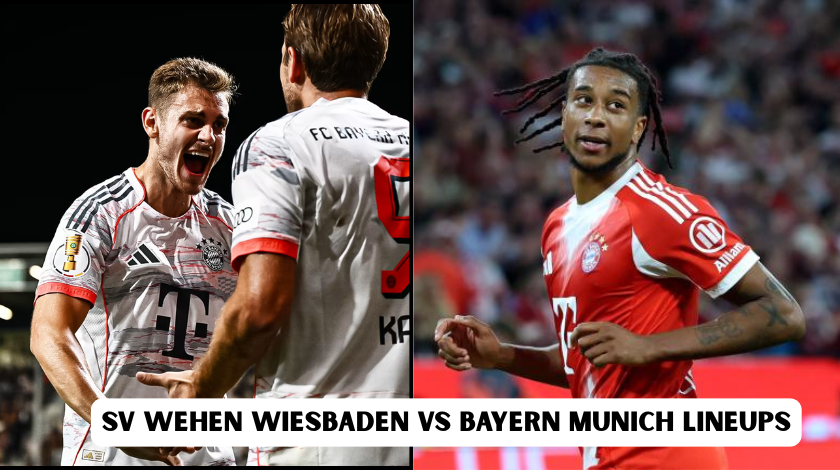
Sv wehen wiesbaden vs bayern munich lineups
There are nights in football when the lineups tell only half the story, and August 27, 2025, was one of them. When SV Wehen Wiesbaden hosted Bayern Munich at the Brita Arena for their first-ever competitive meeting, the team sheets that circulated an hour before kickoff looked exactly like what most fans expected: a heavily rotated Bayern side against a determined but outgunned third-tier outfit. What followed was anything but predictable. The match ended 3-2 to Bayern, but for long stretches, the Bundesliga champions were staring at one of the most embarrassing cup exits in their recent history.
I have been covering German football for over a decade, and I have learned that the DFB-Pokal first round is where reputations are made and destroyed. This was supposed to be a straightforward exercise for Vincent Kompany’s men—a chance to give minutes to squad players while resting stars ahead of a packed season. Instead, it turned into a 94-minute thriller that exposed both the depth and the vulnerabilities of this Bayern Munich squad. The lineups, which looked so balanced on paper, became a study in how quickly football can humble even the biggest clubs when complacency creeps in.
The Context: Why This Match Mattered More Than Expected
Before we dive into the specific lineups, it is worth understanding why this fixture carried more weight than your typical David vs Goliath cup tie. Bayern Munich arrived in Wiesbaden riding on an incredible high. Just days earlier, they had dismantled RB Leipzig 6-0 in the Bundesliga opener, with Harry Kane grabbing a hat-trick and the team looking like they had fully absorbed Kompany’s aggressive, high-tempo philosophy. The Super Cup win over Leipzig had already given them silverware, and confidence was sky-high.
For Wehen Wiesbaden, the situation was different but no less significant. The club, currently competing in the 3. Liga had made a solid, if unspectacular, start to their season—four points from three matches. More importantly, they had a secret weapon that most casual observers missed: two former Bayern Munich academy products in their starting lineup. Justin Janitzek and Ryan Johansson had both worn the famous red shirt at the youth level, and for them, this was not just a cup tie. It was a chance to prove to their former employers that they had made a mistake in letting them go.
The Brita Arena, with its modest 12,500 capacity, was sold out weeks in advance. This was the biggest night in the club’s recent history, and manager Nils Döring knew his team needed to be tactically perfect to have any chance. The contrast in resources was staggering—Bayern’s squad value runs into hundreds of millions, while Wehen Wiesbaden’s entire team might be worth what Bayern pays Harry Kane in a month. But football has never been played on spreadsheets, and the lineups that evening proved that heart and organization can bridge gaps that money cannot.
Breaking Down Bayern Munich’s Rotated Lineup
Vincent Kompany made six changes from the side that destroyed Leipzig, a rotation that seemed sensible at the time but would later be questioned. The most significant absence was Manuel Neuer, though not through injury or rest—the Bayern captain was suspended following his red card in the previous season’s defeat to Bayer Leverkusen. This gave Jonas Urbig his first competitive start for the club, a 21-year-old goalkeeper who had joined from FC Köln with big potential but minimal top-level experience.
In defence, Kompany opted for Raphaël Guerreiro at left-back, Minjae Kim and Jonathan Tah in the centre, and Sacha Boey on the right. This was a back four with plenty of quality but lacking the understanding that comes from playing together regularly. The midfield pairing of Joshua Kimmich and Aleksandar Pavlović offered a blend of experience and youthful energy, though Pavlović was playing his first competitive minutes of the season.
The attacking lineup is where Kompany’s faith in his squad depth really showed. Michael Olise, who had scored twice against Leipzig, kept his place on the right wing. Luis Díaz, the summer signing from Liverpool, started on the left, still searching for his first goal in Bayern colours. But the most interesting selection was Lennart Karl, a 17-year-old midfielder who had impressed off the bench against Leipzig. Kompany handed him his first start, a bold move that showed either tremendous confidence in the teenager or perhaps a slight underestimation of the opposition.
Up front, Harry Kane led the line. The England captain had been in devastating form, and Kompany later admitted that he had considered resting Kane but decided the striker’s rhythm was too important to interrupt. Looking at the lineup as a whole, it had enough quality to win comfortably, but it also had a makeshift feel that would prove problematic under pressure.
When Wiesbaden’s Brave Starting Eleven
Nils Döring set his team up in a 4-4-2 formation that prioritized solidity while also featuring players who could hurt Bayern on the break. Florian Stritzel, a 31-year-old goalkeeper who had spent most of his career in the lower leagues, got the nod between the posts. In front of him, the back four of Sascha Mockenhaupt, Jordy Gillekens, Justin Janitzek, and Niklas May was organized and physical. Janitzek, in particular, was living a dream he had probably imagined a thousand times as a Bayern youth player—facing the club that had released him.
The midfield was where Wehen Wiesbaden’s ambition showed. Rather than packing five players in front of the defence and hoping for the best, Döring selected a four-person unit featuring Tarik Gözüsirin, Donny Bogičević, Lukas Schleimer, and Ryan Johansson. This was a group with technical ability and, crucially, no fear. Johansson, like Janitzek, had Bayern DNA running through his veins, and you could see from the first whistle that both former academy players were determined to make statements.
Up front, the strike partnership of Nikolas Agrafiotis and Fatih Kaya was the perfect blend for a cup upset attempt. Agrafiotis, a 25-year-old Greek forward, had scored twice in the opening three league games and possessed the kind of intelligent movement that could trouble any defence. But it was Kaya, the 26-year-old Turkish-German striker, who would ultimately write his name into Wehen Wiesbaden folklore. As captain, he led by example, and his two goals that night were finishes of genuine quality that showed he belonged on a bigger stage.
What struck me watching the lineups emerge was the age profile. When Wiesbaden’s starting eleven had an average age of around 26, with several players in their prime years who had perhaps accepted that they would not reach the very top but were determined to prove they could compete at a high level. There was no naivety in this selection, no sense of being overawed. Döring had picked a team that knew exactly what it was doing.
The Key Matchups: Where the Game Was Won and Lost
When you analyze lineups in hindsight, you always look for the individual battles that defined the contest. In this match, several went very differently from the pre-match predictions.
Jonas Urbig vs Fatih Kaya: The young Bayern goalkeeper had a difficult evening. While he could not be directly blamed for either goal, his communication with a defence that was constantly changing looked shaky. Kaya, meanwhile, was magnificent. His first goal, sliding in at the far post, showed perfect timing. His second, racing onto a long ball and smashing home, demonstrated pace and composure that Bayern’s centre-backs simply could not handle. This was a mismatch that favoured the underdog.
Lennart Karl vs Lukas Schleimer: This was the battle of the young midfielders, and it was fascinating to watch. Karl, at just 17, showed why Bayern have such high hopes for him. His driving run that led to Olise’s goal was the kind of explosive, direct play that modern football demands. But Schleimer, four years his senior and playing at a lower level, was not intimidated. He matched Karl’s energy and added the physicality that comes from playing regular senior football. It was a reminder that talent needs time and that experience counts.
Harry Kane vs The Wehen Wiesbaden Defence: On paper, this should have been a massacre. Kane is one of the best strikers in world football, while the Wehen defence was assembled from free transfers and lower-league journeymen. Yet for 75 minutes, the home side kept him relatively quiet. Yes, he scored the opening penalty and the late winner, but in between, he was frustrated by the organization and determination of Janitzek and Gillekens. It took a set-piece situation for Kane to break free with his header finally, and even then, he had missed a penalty earlier that would have sealed the game.
The Full-Back Battle: Raphaël Guerreiro and Sacha Boey against Wehen’s wingers was another area where the Bundesliga side should have dominated. Guerreiro, in particular, is a player of immense technical quality, but he looked uncomfortable with the physicality of the occasion. When Josip Stanišić replaced him in the 78th minute, it was an admission that the experiment had not worked. Boey, on the other hand, provided the assist for Olise’s goal with a driving run, but he also got caught out of position for Kaya’s equalizer.
The Dramatic Timeline: From Comfort to Chaos
The match narrative followed the lineups’ story in reverse. When the teams were announced, Bayern fans felt confident. When Kane scored the early penalty, that confidence seemed justified. The first half was largely one-way traffic, with Stritzel making several excellent saves to keep his team in the contest. At halftime, with Bayern leading 1-0, everything seemed to be going according to the script.
The second half began with Olise’s goal, and at 2-0, the tie looked over. This is where the lineups’ limitations began to show. Kompany’s rotated side lacked the killer instinct to put the game away. Díaz had multiple chances to score his first Bayern goal and was denied repeatedly by Stritzel. Kane had another opportunity that he blazed over. When you rotate your squad, you sometimes lose that ruthless edge that comes from playing together regularly.
Then came the six minutes that will live long in Wehen Wiesbaden history. In the 64th minute, Kaya pulled one back. Six minutes later, he equalized. The Bayern defence, which had looked solid on paper, was suddenly exposed. Tah lost track of Kaya for the first goal, and a long ball over the top caught both centre-backs sleeping for the second. Urbig was visibly furious with his defenders, and the Bayern players’ body language suggested a team that had not experienced adversity together.
Kompany’s substitutions were telling. He threw on Leon Goretzka and Serge Gnabry, then later Konrad Laimer and Stanišić. These were not the moves of a manager who had planned for a comfortable evening. These were emergency measures, and they almost were not enough. When Kane missed his second penalty in the 76th minute—his first miss since the 2022 World Cup—the upset seemed possible.
But great players find ways even when everything is going wrong. In the 94th minute, Kane rose to head home the winner, his second of the night and his 30th consecutive successful penalty conversion before that miss. It was cruel on Wehen Wiesbaden, but it was also a reminder of why Bayern Munich are Bayern Munich. Even when their lineup is not perfect, even when they play poorly, they find ways to win.
What the Lineups Tell Us About Both Clubs
Looking back at those team sheets, there are lessons for both clubs. For Bayern Munich, the match exposed the gap between their first-choice eleven and their rotated squad. Players like Urbig, Karl, and even Díaz, to an extent, showed promise, but they also showed they are not yet ready to carry the team when the pressure is on. This is not a criticism—it is a reality of squad building. You cannot have 25 world-class players, and the drop-off between starters and backups is natural.
However, Kompany might reconsider his approach to cup ties against lower-league opposition. The risk with heavy rotation is not just that you might lose—it is that you put young players in situations where their confidence can be damaged. Karl played well, but he was part of a midfield that lost control of the game. Urbig’s first start will be remembered for the two goals he conceded in quick succession, even if they were not his fault. These are learning experiences, but they are painful ones.
For Wehen Wiesbaden, the lineups showed a club that knows its identity. Every player in that starting eleven understood their role and executed it with passion. Janitzek and Johansson proved that the Bayern academy produces players who can compete at a high level even if they do not make it at the Allianz Arena. The discovery of the night was Kaya, who showed that he is capable of playing at a higher level. Do not be surprised if scouts from 2. Bundesliga or even bottom-half Bundesliga clubs were taking notes.
The match also highlighted the value of continuity. When Wiesbaden’s lineup featured players who had played together for weeks and months, they knew each other’s movements, they trusted each other in defensive situations, and they celebrated together like a true team. Bayern’s lineup, by contrast, looked like a group of talented players still learning to play together.
Expert Analysis: Was Kompany’s Rotation Too Risky?
In my opinion, Kompany got away with one here, and he knows it. In his post-match comments, he called it a “crazy game” and admitted that Bayern had “big, big chances to put the game away” but failed to take them. He praised Wehen Wiesbaden’s spirit, which is the polite way of saying his team underestimated the opposition.
The rotation itself was not the problem. Bayern have a long season ahead with Champions League commitments, and keeping players fresh is essential. The issue was the balance of the rotated lineup. Starting both Karl and Pavlović in midfield was brave, perhaps too brave for a tricky away cup tie. Resting Neuer was forced, but the defence in front of Urbig needed more leadership than it received.
I would have preferred to see one or two more experienced heads in that starting eleven. Starting Goretzka instead of Karl, for example, would have given the midfield more control without necessarily compromising the teenager’s development—he could have come on later with the game more settled. Similarly, while Díaz needs minutes to find his form, a cup tie away to motivated lower-league opposition might not have been the ideal setting for him to build confidence after his transfer.
That said, managers are judged on results, and Kompany delivered. Bayern are through to the next round, and the experience will have taught their young players valuable lessons about the demands of representing this club. Sometimes you need a scare to appreciate the danger, and this was certainly a scare.
Conclusion
The SV Wehen Wiesbaden vs Bayern Munich lineups from August 27, 2025, will be remembered not for the names on the teamsheet but for the drama that unfolded once the whistle blew. What looked like a straightforward rotation exercise for Bayern turned into a 94-minute examination of their squad depth, their mentality, and their ability to win ugly. For Wehen Wiesbaden, it was a night that proved they can compete with the very best, even if the final result was heartbreaking.
For fans and analysts, this match is a reminder that lineups are just the starting point. The real story is written by the players who step onto the pitch and the moments they create. Fatih Kaya’s brace, Lennart Karl’s promising debut, Harry Kane’s late rescue act—these are the memories that will last longer than any tactical analysis.
As the DFB Pokal progresses, Bayern Munich will face tougher opponents with stronger lineups. But they may not face a test as character-building as this one. And for SV Wehen Wiesbaden, the pride of pushing the German champions to the brink will sustain them through the long winter months of 3—Liga football. Sometimes in football, you can lose a match but win something far more valuable: the knowledge that you belong on the same stage as the giants.
Frequently Asked Questions (FAQ)
Q: Why was Manuel Neuer not in the lineup for Bayern Munich against Wehen Wiesbaden? A: Manuel Neuer was suspended for this match due to a red card he received in the previous season’s DFB Pokal defeat to Bayer Leverkusen. This suspension forced Bayern to start Jonas Urbig, a 21-year-old backup goalkeeper, in what was his first competitive appearance for the club.
Q: Who made their debut for Bayern Munich in this match? A: Lennart Karl, a 17-year-old midfielder, made his first start for Bayern Munich after impressing as a substitute against RB Leipzig. He provided an assist for Michael Olise’s goal with a driving run into the box, showing why the club has high hopes for his future.
Q: Which former Bayern Munich academy players started for Wehen Wiesbaden? A: Two former Bayern youth products featured in Wehen Wiesbaden’s lineup: defender Justin Janitzek and midfielder Ryan Johansson. Both players went through the Bayern academy system but were released and ended up in the third tier, making this match particularly meaningful for them.
Q: What formation did Wehen Wiesbaden use against Bayern Munich? A: When Wiesbaden manager Nils Döring set his team up in a 4-4-2 formation, with Florian Stritzel in goal, a back four of Mockenhaupt, Gillekens, Janitzek, and May, a midfield quartet of Gözüsirin, Bogičević, Schleimer, and Johansson, and a strike partnership of Agrafiotis and Kaya.
Q: How many changes did Vincent Kompany make from the team that beat RB Leipzig 6-0? A: Kompany made six changes to his starting lineup. Jonas Urbig replaced the suspended Manuel Neuer in goal, while there were also changes in defence and midfield. The most notable inclusion was 17-year-old Lennart Karl, who earned his first start for the club.
Q: Who scored the goals in the Wehen Wiesbaden vs Bayern Munich match? A: For Bayern Munich, Harry Kane scored twice (a penalty in the 16th minute and a header in the 94th minute), and Michael Olise scored in the 51st minute. For Wehen Wiesbaden, captain Fatih Kaya scored both goals in the 64th and 70th minutes, briefly levelling the score at 2-2.